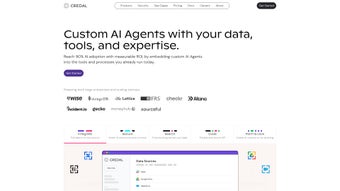

Download Credal – Secure AI Integration for Enterprises
Enterprises today are racing to embed generative AI into their workflows, yet the rapid pace often leaves data‑security considerations in the shadows. Credal arrives as a purpose‑built gateway that bridges the gap between powerful language models and strict corporate compliance regimes. By delivering automatic data masking, policy‑driven controls, and end‑to‑end auditability, Credal enables businesses to unlock AI‑driven productivity without compromising on privacy or regulatory obligations. In the sections that follow, we’ll explore why a secure AI layer is essential, dive deep into Credal’s capabilities, walk through installation and compatibility, and finally weigh the pros, cons, and common questions that help you decide if Credal is the right fit for your organization.
Why Enterprises Need a Secure AI Gateway
Artificial intelligence has become a strategic asset for modern businesses, but the rush to adopt tools like ChatGPT often overlooks a critical factor: data protection. Sensitive information—personally identifiable information (PII), intellectual property, financial records—can inadvertently slip through an AI interface if proper safeguards are not in place. That is where Credal steps in. Designed as a secure AI integration layer, Credal gives organizations the confidence to leverage powerful language models while keeping their data locked behind robust security controls. The platform acts as a broker between corporate data sources and external AI services, automatically applying masking, redaction, and policy enforcement without requiring developers to write custom security code.
This “security‑by‑design” approach not only reduces the risk of data leakage but also helps companies stay compliant with regulations such as GDPR, CCPA, and HIPAA. In an era where a single data breach can damage brand reputation and incur hefty fines, Credal offers a pragmatic solution that blends AI productivity with enterprise‑grade security. Whether you are a large multinational or a fast‑growing startup, the ability to harness AI responsibly is a competitive advantage—one that Credal makes attainable for any organization that values data integrity.
Beyond compliance, a secure AI gateway simplifies internal governance. Security teams can define global policies that automatically propagate to every AI request, eliminating the need for manual checks or ad‑hoc approvals. This consistency not only accelerates time‑to‑value for AI projects but also creates a clear audit trail that satisfies auditors and senior leadership alike. By centralizing control, Credal reduces the operational overhead associated with managing multiple AI integrations across departments, making it easier to scale AI initiatives without sacrificing oversight.
Overview of Credal’s Core Capabilities
Credal is a web‑based application that sits between your internal systems and external AI providers. Its primary mission is to ensure that any data flowing through AI models is automatically inspected, sanitized, and logged. The platform supports popular AI engines, including OpenAI’s ChatGPT, and can be extended via a set of RESTful APIs for custom model integration. Credal’s secure chat interface lets end‑users interact with AI tools while the backend silently enforces data‑handling policies.
For developers, the integration SDK simplifies embedding AI features into existing applications, handling token‑level redaction and permission checks on the fly. Administrators benefit from a centralized policy dashboard where they can define rules based on data classifications, user roles, and compliance requirements. Every request and response is captured in immutable audit logs, enabling full traceability for internal reviews or external audits. In addition, Credal can be deployed on‑premise or within a private cloud, ensuring that organizations retain full control over where data resides.
The combination of automatic masking, policy‑driven access control, and comprehensive logging makes Credal a decisive tool for any enterprise looking to embed AI while staying within strict data‑protection frameworks. Its modular architecture also allows for future expansion—new AI providers, additional compliance templates, and custom analytics can be added without disrupting existing workflows, safeguarding your investment as the AI landscape evolves.
Feature Deep Dive – What Sets Credal Apart
- Secure AI Gateway: Acts as a protective barrier between internal data stores and external AI services, applying real‑time redaction and masking.
- Policy Engine: Define granular access policies based on data sensitivity, user role, and regulatory mandates; enforced automatically on every request.
- Audit Logging & Reporting: Immutable logs capture who accessed what AI model, when, and with which data, supporting compliance audits.
- Multi‑Platform Integration: Native connectors for Google Drive, Slack, Microsoft Teams, and custom REST APIs allow seamless embedding of AI across existing workflows.
- On‑Premise & Private Cloud Deployment: Docker‑compatible images and Helm charts enable deployment within your own network, eliminating data residency concerns.
- Developer SDKs: Language‑agnostic SDKs (Python, JavaScript, Java) provide easy hooks for token‑level data sanitization and permission checks.
- Automatic Data Classification: Built‑in ML models detect PII, financial data, and other high‑risk content, triggering masking rules without manual configuration.
- Real‑Time Monitoring Dashboard: Visual insights into AI usage patterns, policy violations, and system health help security teams stay ahead of threats.
- Scalable Architecture: Horizontal scaling through Kubernetes ensures low latency even under heavy AI request loads.
- Compliance Ready: Pre‑configured templates for GDPR, CCPA, HIPAA, and ISO 27001 accelerate regulatory alignment.
Each feature is designed with the enterprise workflow in mind. For example, the policy engine can inherit role‑based access controls from your existing identity provider (IdP), meaning you don’t have to duplicate user management. The automatic data classification layer continuously learns from new data patterns, reducing false positives over time and ensuring that masking stays accurate as your business evolves. Moreover, the real‑time monitoring dashboard integrates with popular SIEM solutions, allowing security operations centers to correlate AI‑related events with broader threat intelligence.
The modularity of Credal also means that organizations can start small—perhaps protecting a single chatbot—and expand to cover all AI‑driven services across the enterprise. Because the platform supports both on‑premise and cloud deployments, you can adopt a hybrid model that satisfies data‑locality requirements while still benefiting from the scalability of managed services. This flexibility, combined with deep technical capabilities, makes Credal a future‑proof investment for any data‑centric organization.
Installation, Usage & Compatibility Guide
Getting Credal up and running is straightforward for teams familiar with containerized deployments. The platform is distributed as a Docker image, and a Helm chart is available for Kubernetes environments. Begin by pulling the latest image from the official registry:
docker pull credal/secure-ai-gateway:latestNext, create a configuration file (credal.yaml) where you define your data‑masking policies, AI provider credentials, and integration endpoints. The file supports YAML syntax for easy readability and can be version‑controlled alongside your infrastructure code. For on‑premise installations, map a persistent volume to store audit logs securely:
docker run -d \
  -p 8080:8080 \
  -v /var/credal/logs:/app/logs \
  -v /path/to/credal.yaml:/app/config.yaml \
  credal/secure-ai-gateway:latest
Once the container is running, access the web UI at https://localhost:8080 to configure policies, add AI model keys, and set up source‑system integrations (Google Drive, Slack, etc.). The UI guides you through a wizard that validates your settings and performs a test request to ensure everything works as expected.
Operating System Compatibility (itemprop="operatingSystem"): Credal supports any environment capable of running Docker, which includes Windows 10/11 (with WSL2), macOS (Catalina and later), most Linux distributions (Ubuntu, CentOS, Debian), and cloud‑native platforms like AWS ECS, Azure Container Instances, and Google Kubernetes Engine. The SDKs are platform‑agnostic, allowing developers to embed Credal’s security layer in desktop applications, web services, or mobile back‑ends.
For teams that prefer a managed service, Credal also offers a hosted option where the infrastructure is maintained by the vendor, and you simply connect via API keys. Regardless of deployment model, the usage pattern remains consistent: send a request to the Credal endpoint, include the data payload, and let the gateway handle masking, policy enforcement, and forwarding to the AI model. Responses are returned with any sensitive content already redacted, giving end‑users a safe and seamless AI experience.
Ongoing maintenance is minimal. Updates are delivered as new Docker tags, and the Helm chart supports rolling upgrades without downtime. Configuration changes can be applied on the fly via the dashboard, and the built‑in health checks integrate with Kubernetes liveness and readiness probes, ensuring high availability in production environments.
Pros, Cons, Frequently Asked Questions & Final Verdict
Pros
- Enterprise‑grade security without sacrificing AI usability.
- Automatic data classification and redaction reduces manual effort.
- Comprehensive audit logs simplify compliance reporting.
- Flexible deployment—on‑premise, private cloud, or managed SaaS.
- Rich SDKs and connectors accelerate integration with existing tools.
Cons
- Initial configuration may require collaboration between security and development teams.
- Performance overhead is minimal but present due to real‑time masking.
- Pricing model for the hosted version can be higher for very large request volumes.
FAQ – Secure AI Integration with Credal
Can Credal work with AI models other than ChatGPT?
Yes. Credal provides a generic REST API that can forward requests to any LLM endpoint, including Anthropic, Cohere, and self‑hosted open‑source models. You simply configure the target URL and authentication token in the policy dashboard.
Is there a free trial or community edition?
Credal offers a 30‑day free trial of the hosted SaaS version, and a fully functional community Docker image for on‑premise testing. The community edition includes all core security features but omits advanced analytics dashboards.
How does Credal ensure data never leaves my network in an on‑premise deployment?
When deployed on‑premise, Credal runs inside your firewall and communicates only with internal services or external AI providers through a whitelisted outbound proxy. All logs are stored on local volumes, and no telemetry is sent to external servers unless explicitly enabled.
Can I customize the masking rules for industry‑specific data?
Absolutely. Credal’s policy engine supports custom regular expressions, dictionary‑based entity lists, and even plug‑in ML classifiers. This flexibility lets regulated industries such as finance or healthcare define precise redaction criteria.
What kind of support is available for enterprise customers?
Enterprise subscribers receive 24/7 SLA‑backed support, a dedicated account manager, and access to premium training webinars. On‑premise customers can also request on‑site workshops for deeper integration assistance.
Final Verdict & Call to Action
In today’s AI‑driven landscape, the tension between innovation and data protection is real. Credal resolves that tension by offering a transparent, policy‑centric gateway that lets enterprises harness the power of large language models without exposing confidential information. Its blend of automatic data classification, robust audit capabilities, and flexible deployment options makes it a compelling choice for any organization that treats data security as a non‑negotiable priority. If you’re ready to empower your teams with AI while staying compliant, download Credal today or request a live demo to see the platform in action.



.png)